Yiddish Curiosities: a library of wonderful but forgotten Yiddish songs from the late 1920s and after (includes Polish Jewish Cabaret). Have a listen!


1. Link to list of posts on this site
2. Link to songs for sale
3. Click here for our music videos of Yiddish songs with English subtitles (mainly post-1925)
4. List of the still lost songs. Do you know any of them?

Monday, August 17, 2026

Lebedik Yankel (Lebedig Yankl, Lebedig Yankel)

UPDATE: Reposted to add the new singalong Yiddish music video, part of my campaign to get other people to sing these songs:


Or visit to the whole track from our cd of the same name: Lebedik Yankel.


This is yet another song about a guy who is not supporting his family because he's too busy praying. Well, he does have an occupation of sorts: he repairs crummy old shoes. (This guy doesn't look very lively, does he!?)

Itzik Zhelonek labeled it "folk song sung by Herman Fenigstein." Morris Rund, however, copyrighted the lyrics and credited Aaron Lebedeff (or Lebedoff as it says on the card in the copyright office card catalog) as composer of the music. For the sheet music I transcribed an older recording of this song sung by Aaron Lebedeff, but that cut was taken down. If that was for copyright reasons, it was unnecessary, as Lebedeff never renewed the copyright and the song is now in the public domain. Luckily somebody else has posted a newer version by Lebedeff (it desn't have the chorus members who were on the previous recording): Aaron Lebedeff's Lebedik Yankel.

I found the last verse not on the recording or in the Zhelonek collection, but online.

I chose this as the name of the second Itzik Zhelonek cd because it was one of the few titles I thought everybody would pronounce. I didn't use the YIVO-sanctioned spelling of "Yankl" because it would worry English speakers.

This song contains the worst tongue-twister I've ever encountered in my life - "zorg zikh nisht mayn vaybl, zorg zikh nisht mayn taybl." I practiced it over and over and still couldn't get it. I was tempted to substitute something that's easier to say.

When Randy came up from Florida, he added the chorus and I added some oom-pah on fiddle and viola.


Translation of the Yiddish lyrics:

» » Read the rest of the article » » » »

Labels: , , , ,

Thursday, July 30, 2026

A sakh melokhes, veynik brokhes (A lot of jobs, not much luck with any of them) Aaron Lebedeff's complaint

UPDATE:I've put this version on youtube with singable transliteration and translation.
Yiddish theater song a sakh melokhes


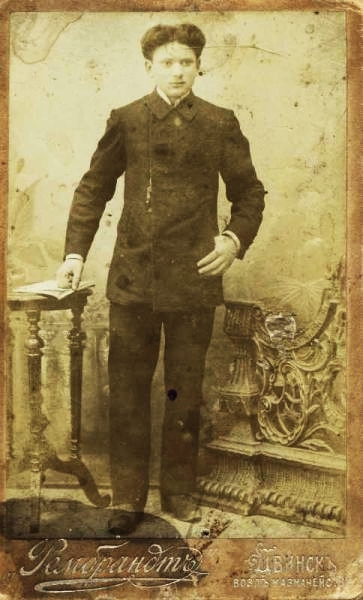
Click the album cover to hear and/or buy the song from our Lebedik Yankel cd, with Randy Kloko singing the guy who just can't get a break no matter how many jobs he tries. (The picture is one of the few I could find of a YOUNG man in a shtetl: I figured the narrator must be relatively young since he isn't "lacking for girls"...)

Young Jewish man in shtetlThe song was sung in Kalmanovitsh's 1924 show 'Dem tatn's zundele' and Zylbercweig credits Peretz Sandler as lyricist. In the manuscripts of the Hebrew Actors' Union housed at YIVO, "Dem Tatns Zindale" is credited to lyricist Oscar Ostroff and composer Ilia Trilling. However, in the Library of Congress one finds the song copyrighted in 1928 by lyricist Morris Rund and composer Herman Wohl. Morris Rund registered a tremendous number of copyrights of Yiddish theater songs - did he actually write them or were his claims false? How can we ever know?

This song is only hard to find because of the weird ways the title is spelled. For instance, it was copyrighted in 1928 by (lyrics) Morris Rund (melody) Herman Wohl, spelled: "Asach meluches in weinig bruches" ...

... and a youtube video: Aaron Lebedeff's "A sach Meluches wenig Bruches"

But it appears on another Aaron Lebedeff (Lebediev, Lebedev, Lebedef) recording (available at Amazon for a buck!) as A Sach Meluches Veinig Bruches.

Until YIVO created a "standard Yiddish transliteration" there was no system, everybody spelled Yiddish in English differently -  many people still resent the standard system of approximating Yiddish sounds and refuse to use it.

The reason this matters is that search engines can't find references to Yiddish words phonetically, you have to guess what spelling the content generator used.

The song was sung in the show 'Dem tatn's zundele.' Some cite Peretz Sandler as having written the words though Morris Rund cited himself as lyricist in the copyright. Morris Rund has a tremendous number of copyrights of Yiddish theater songs - did he write them or merely claim them falsely? How can we ever know?


Here's my translation:

» » Read the rest of the article » » » »

Labels: , , ,

Sunday, June 14, 2026

Di naye 'Al Chet' - a song for Yom Kippur if you're feeling a bit sardonic

UPDATE: Reposted to add a new youtube version of this song with text and translation:


Now that I have my own copy of Heskes, I see that she references quite a few songs called "The New [name of some prayer]." I assume they follow the form of this one and the other I've posted, "Lo Lanu (Loy Lani)" - they start in the synagogue, assuming the audience knows the context of the prayer they cite, and then go on to put the concept into more secular situations.

In this case: singing a smidgen of Al Chet (the Yom Kippur prayer which lists our sins), each character in his/her own verse grudgingly admits wrongdoing and asks forgivenness (and a good year).

This one: copyright 1928, words by Morris Rund, music by Sholom Secunda. It's a strange tune. Aviva Enoch is playing piano, thanks, Aviva. Randy Kloko sings bass on the chorus.

There are three verses in Zhelonek; the Pesach Burstein version, from which I transcribed the melody, also has three verses, completely different. The first verse I sing is the second Zhelonek verse. Burstein's first is: "On Yom Kippur God forgives all Jews for their sins. We beg, with fear and terror, that the Creator will provide happiness, health and livelihood. For the sins we have committed before Thee... The old Reb Zishe prays to God: "Maybe I sinned before you because I looked at another woman."


Here's my Yiddish translation of the version I sang:

The butcher's wife Natke stands in the meat market
She doesn't want to get the least bit thinner.
She sells bones to all her customers and saves the shnitzel for herself.
For the sins we have committed before Thee...
Poor thing, she begs compassion from the Creator:
"I'm not the slightest bit concerned
about my customers, it's only You I fear."

Chorus: Master of the Universe, hear my petition,
don't punish me like a sinner, send me happiness and a livelihood.

And the shoemaker's tears are also pouring:
"Oh God, help me quickly! I haven't got any money in the purse
but there are shoes to make and soles to repair.
For the sins we have committed before Thee...
Oh, dear Father, maybe I sinned because I made some crummy patches..."

Reb Khayem shouts, but nobody's listening:
"I've been underground for years.
People drive cars now, it's hard to earn, nobody needs a horse shod.
For the sins we have committed before Thee...
Oh, God, what's the point? Perhaps I sinned before you
and did a shoddy job shoeing a couple of horses..."

Labels: , , , ,

Tuesday, March 10, 2026

A badkhn-lid (Jewish wedding song of long ago)

UPDATE: I first heard this song long, long ago when I was recording for Sheva Zucker's set of Yiddish language cassettes. I did half the songs and Sender did the other half and he sang this song, but I really liked it, so in 2014 I recorded it in my living room and put it on this blog.

This blog was recently hacked and I spent spent a couple days going through all the posts to extinguish links to the Malaysian gaming site that had gotten hold of it. So when I got to this song, it turned out the soundcloud link was dead. Why? I don't know. So then I thought, no problem, I'll just find it on my computer and put it up on youtube. Except I couldn't find my recording. It wasn't on my computer, or on my hard drives or flash drives. It was just gone.

So, I recorded it again a couple weeks ago. I asked Sheva where she had gotten the song, and she said it was at Josh and Reyzl's wedding, and I wrote to Josh to ask him where HE found it, but he didn't answer, so I can't tell you.


Back in the old days, the crying at weddings was not just from joy. Marriage wasn't easy, especially for the new wife. The wedding entertainer or Master of Ceremonies, the badkhn, was tasked with reminding the assembled multitude that with life as well as with dinner, it's often not very good and the portions are always too small.


English translation of the Yiddish after the jump:

» » Read the rest of the article » » » »

Labels: , , ,

Friday, October 28, 2022

Lo lanu di naye (Yiddish theater song) (Lo Lani)

UPDATE: Reposting to add the animated video I did today. Nobody ever listens to the automatic videos created by Routenote of the songs from our cds so I thought I'd make one today and see if it gets some listeners:


Here's something very interesting about the fellow I called here (in the second verse) "Vayzote" but who, it seems, is called in Yiddish Vayzuse and whose name is also used for "idiot." He was Haman's youngest son. You can read a great blog article about him, from the Mayrent Institute blog, here: Vayzuso. And there is a wonderful recording from way back in 1901 made by Dave Franklin, "the king of comic singers." A great song and a great read!


Click the picture to listen to and/or buy this track, Di naye lo lanu, from our Lebedik Yankel cd. Aviva Enoch plays the piano on the cd.

(Picture: Mordechai on his horse, as mentioned in the song!)

And here is a live concert version with Roger Lynn Spears playing piano:


This song was printed twice in the collection (once in 1929 and once in 1934) which indicates it must have been pretty popular! As with "Di Naye Al Chet" and "Me Shoklt Zikh," the song begins in a religious setting (pious Jews praying at Sukkot and waving their lulavs). It plays with the line from the Halleluja, "Lo Lanu" (not for us but for you, God) and the similar "lo eleinu" which means more or less, "let it not happen to me/us!" Having set the proper context, it then wanders off and applies the concept in a more secular context.

Aviva and Roger both do a great job of interpreting the accompaniment as heard on the Herman Fenigstein 78 found at Harvard's Judaica Collection. (Fenigstein sings the same first verse as noted in Zhelonek's book, but his second and third verses are different.) Although ordinarily I adapt lyrics to standard Yiddish (because that's what I know), in this case many of the rhymes won't work unless one sings "Lo lani" (what he sings sometimes sounds more like "Loy lani") so that's what I did.


» » Read the rest of the article » » » »

Labels: , , , , , , , ,

Sunday, July 3, 2022

Yosl un Sore-Dvoshe: a tale of a lover's spat which culminates in a noisy trip to the theater

UPDATE to add video from our May 2022 concert at the Shadowbox. We just did the first two verses and went out with a bass solo.

This is Kasriel Broydo's send-up of Fanny Gordon's tango Milosc cie zgubila.That's Fanny in the picture. She was the only female composer I know of working successfully in the Polish cabarets and nightclubs between the World Wars.

This Yiddish version was sung in Europe by Mina Bern and Joseph Widetzky.

I love how the loving couple displays behavior that must have been so aggravating to the singers: they sneak into the theater for free, they snap and crunch sunflower seeds and cookies in the front row and they even eat fruit compote and nudge around with their pal Velvl.


You can listen to or buy the cut from our album here: Yosl un Sore-Dvoshe on Cabaret Warsaw: Yiddish & Polish Hits of the 1920s - 1930s by Mappamundi


Here's my translation from the Yiddish:

» » Read the rest of the article » » » »

Labels: , , , ,

Thursday, June 23, 2022

Der Dales - Nikodem - Yiddish and Polish versions of the same theater song

UPDATED to add a video made from our May 8 2022 concert. 

When my band Mappamundi was making the Cabaret Warsaw cd, we were looking for songs from the 1920s and 1930s which had both a Polish and a Yiddish version, and this song was one of them.

We wondered which came first until I found, at YIVO, Ben-Zion Witler's copy of this published sheet music for Nikodem with his own handwritten lyrics, in Yiddish, tucked inside. In my later research I've found several Polish songs which he re-wrote for his own repertoire.

The Polish version is about an obnoxious guy who thinks he's hot stuff. Witler's version is more interesting - it's about the anthropomorphized concept of Poverty as a sentient creature who comes to live with you and, sadly, like a leech of an uninvited guest, will not leave.
 

We recorded it for our Cabaret Warsaw cd: Der Dales and Nikodem by Mappamundi. We sing two of the three verses Witler recorded and then just the chorus of the Polish version (Nikodem) by Starski and Wars.

Here's my translation of the Yiddish lyrics. For a charming description of "Der Dales" (Mr. Poverty) see the bottom of this post.
» » Read the rest of the article » » » »

Labels: , , , , , , , ,

Wednesday, June 22, 2022

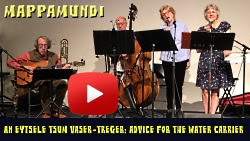
An eytsele tsum vaser-treger (Advice for the water carrier) - Moyshe Broderson and Henech Kon

UPDATE: We recently got a rare opportunity to sing this song, at the Shadowbox Studio. Paul Deblinger filmed it and Mark Sidell ran sound off the board and so here is a new video.

Way back in 2010, Beth Holmgren and I were very taken by a video we heard on Youtube of Ola Lilith and Willy Godik singing together, An'Eicele, 1928 - "(Text Moses Brodersohn, Musik H. Kohn) - Ola Lilith u. Wł. Godik aus jüdischen Revue-Theater, mit Orchester Begleitung, Homocord Pl.29078, Wyrób Polski (Polish) c. 1928"

In standard transliteration that would be An eytsele (Some Advice).

I wasn't satisfied with my ability to transcribe the words and, besides, it was about women from various places and how lousy they would all be as wives, we didn't want to sing that. So I replaced the text with one from the Itzik Zhelonek's lost songs, one that at the time was still lost (ie had no melody) but which I have since found: Der vaser treger as sung by Moshe Kraus. Though I didn't know it then, Der vaser treger was also written by Moshe Broderzon and Henech Kon. I added a different punch line. (In the original song, the punch line is, "so we don't have any potatoes to go with our bread - God will provide.")

Here's us singing the concocted song for the first time:


Here are the words. If you ever sing it (or any of the others) please let me know and I'll link to your performance!
» » Read the rest of the article » » » »

Labels: , , ,

Thursday, September 9, 2021

Birobidzhan: Stalin thought you should want to live there and this song agrees.

UPDATE: Somebody asked me for a sing along version, so here it is, the recording is still from "I Can't Complain" at Bandcamp
This Yiddish song of propaganda and emigration is often called Yugn Zikh Tsvey Taykhn - lyrics by Betsalel Friedman and music by Ben Yomen. I didn't know this until yesterday and when I looked up Ben Yomen's songbook Lider far shul un heym I found it (thanks to Jack Falk):

Yiddish song Birobidzhan original sheet music

There is also a cute song in the book called The Biro Bidzhan Freylekh. I can only assume Ben Yomen sincerely believed Birobidjan could be a good place for Jews to settle.

I was very startled to see this sheet music, because it's so different from what I learned - somewhere along its way to me the melody morphed into something quite different. I've never heard a recording of the song: I learned it from a pianist who had learned it from a cassette (which he can't find for me now).

Click below to hear the version Aviva and I recorded (and buy the sheet music of our version, if you like it):


This is the video Aviva and I made at our first concert together:

» » Read the rest of the article » » » »

Labels: , ,

Sunday, February 7, 2021

Dir a nickel, mir a nickel - from Fishel der gerotener, a song about getting ahead as a trolley conductor

This song is in the Kemmen Folio of Famous Jewish Theatre Songs I bought on eBay. It's from the show Fishel der gerotener. Gerotener means a well-made, all round class A type of person, but Menashe Skulnik played the hapless trolleyman so you know the nickname was sarcastic. The lyrics are by Isidore Lillian and the music is by Joseph Rumshinsky.

It could be "Dir a nikl mir a nikl," but the correct way to spell nickel in Yiddish is problematic, since at the time the Jews were cramming English into their vocabularies as fast as possible. You'll also find it as Fishl der Konduktor. Fishel is enjoying the shmirn (smears, bribes) that come his way.

The idea was stolen from a previous (1917) Yiddish theater hit, Fifty-fifty, in which we see:

Mayn bruder iz arumgegangen gebrokhn a lange tsayt.
Keyn zakh iz im nit gelungen, vos er hot getrayt.
Af eyn mol kumt er aheym mit gelt un zogt tsu mir; you see,
Ikh bin conductor af a kar un teyl zikh mit der company—

Fifty-fifty, Fifty-fifty, oy oy oy, fifty!
Ikh kling di bel gor on a shier.
A nickel far zey un a nickel far mir;
Fifty-fifty! es geyt bay mir af stim.
A tsi dos shtrikl, s'iz do a nickel
Mit fifty-fifty-skem!
My brother's been going around broke for a long time. Nothing he's tried has been a success. Once he came home with money and told me: "You see, I'm conductor of a trolleycar and share with the company: Fifty-fifty! I ring the bell endlessly, a nickel for them and a nickel for me! It's going gangbusters. A tug on the string, there's a nickel, with the fifty-fifty scheme!"

I hadn't intended to make a video of this song because Bruce Adler did a great one, with subtitles, and an orchestra! His version is featured at the Milken Archive where you can read the plot of Fishl der gerotener. (I have special interest in this show because Ola Lilith played one of the love interests.)

But then my friend Aviva Enoch and I ended up doing a version one afternoon just for fun and I forgot about it until I started trying to figure out why the song "Fifty-fifty" sounded so familiar... Anyway, the file lay in my computer for six years. Here it is.


If you want the sheet music with lyrics, translation, chords, etc., here it is:


My translation:

» » Read the rest of the article » » » »

Labels: , , , , ,

Monday, February 11, 2019

In a hoyz vu men veynt un men lakht (In a house where one cries and laughs) - Yiddish song about a brothel.

UPDATE: Vivi Lachs sent me pdfs of a magazine called Lider Magazin, published in New York at the turn of the century, and I just found in Issue #9 a text for this song which is the basis for what was sung to Ruth Rubin! It's too bad the song sheet is so torn up but here it is (click it for larger view):


Previous update: Avery Gosfield recently gave me a new word for this kind of song, it's a contrafactum: "the substitution of one text for another without substantial change to the music." I've been calling them parodies, but parody to me implies humor or sarcasm, and in this case, neither is present. She also used 'canta si come' - so thanks, Avery!

Here's the video:


Or click below to buy the song or the whole album (In Odess) at Skylark Productions:


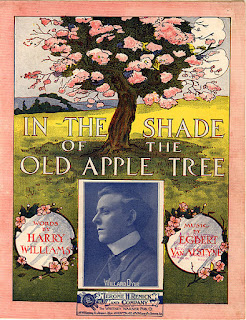
in the shade of the old apple treeIn the 1950s ethnomusicologist and Yiddish enthusiast Ruth Rubin recorded many 10" tape reels of Yiddish songs, some now vanishingly obscure. One of the "lost" songs from the Itzik Zielonek collection was in the Rubin collection; it was sung by a Mrs. Dillman in the 1950s in Montreal. The tapes reside at the New York Public Library but it was Lorin Sklamberg at YIVO who kindly sent me the a capella verse-and-a-half on this reel.

Itzik has it as "In a hoyz vu men veynt un men lakht" but the Ruth Rubin recording has: "In dem hoyz..." The title means: "In a house where there's tears and laughter" (or "In the house where people cry and laugh"). There was supposedly a recording in 1912 by L. Braun on a Syrena Grand Record, In der haus wu men weint un men lacht, but I've never heard it.

I recognized the tune but couldn't remember the name, so I turned to one of those "name this tune" internet services and turns out it's from a 1905 song by Egbert Van Alstyne (original words: Harry H. Williams) called "In the Shade of the Old Apple Tree." I wonder if perhaps this Yiddish song became so thoroughly lost because this tune is so completely un-Jewish and its sweet, sentimental affect is so bizarre paired with these dark lyrics.

Being so Gilded Age and goyish, the song is not typical of the Zhelonek collection. Aviva Enoch and I recorded it in March 2013 and Randy Kloko added baritone on the chorus.

The version printed by Zhelonek is about a whorehouse. I wonder which came first? Here are his lyrics, which do not scan very well. I was especially pained by the word tsuzamen (together) which should have the accent on the second syllable but which fits in this chorus only with the accent on the last syllable.

Just think, now, people,
how life goes for mankind these days.
People rush around and slave away.
Things go well for one who's blessed
But you don't know what will happen later
Think about this now, pay attention
to one thing: don't send your wife and child away ...

In a house where one cries and laughs
I once spent a whole night
I saw women and men together there
In a house where there's laughter and tears

I went into a house,
I saw a very sad young girl
I went to her, she cried many tears in front of me
She begged: "Young man, save me! I don't want to be here. I was deceived away from my home by a young charlatan, and here I suffer from hunger and pain."

I became acquainted with a woman,
she was young and pretty then
Late at night I fooled around
with her in a dancehall
When we sat by a little table and
drank champagne, I wanted to leave,
she said to me: "No, young man,
you'll be with me today."

I ask her, "Tell me, dear woman,
Where did you come from, to end up here?"
See how the woman doesn't answer,
In her eyes one sees a lament:
"I had a husband and two children
Things were good for me then
I parted from him and had nowhere to go
I was forced, a poor thing, to come here."


The version Mrs. Dillman sang has a few English words in it and is more literally about a (tenement) house in which there are happy people and sad people.

In the house where one cries and laughs
Where the landlord comes into the tenement to get his rent
And it makes people sweat
Where the greenhorn quickly becomes ?
And the rooms are as dark as in a jail
From the basement to the roof, each gets a punishment
In the house...

Sunday the tenement house is noisy
On each floor it's a different scene
On the first floor a girl plays piano
On the second floor a sick person grows still
On the third floor a bride is getting ready
On the fourth floor a corpse is lying
The bride is taken to the wedding canopy
The corpse is taken to the grave

In the house where there's crying and laughter
So much trouble, day and night,
They wish the bride good luck
The corpse never comes back
In the house...

Labels: , ,

Tuesday, August 21, 2018

Tsen kopikes hob ikh (I have ten kopecks) - Aaron Lebedeff hit - first of the new shlager series!

At "Trip to Yiddishland 2018" last week I was talking with Alec Burko about his amazing project, the Yiddish Dialect Dictionary. We both love obscure corners of Yiddish culture. I said "people are only ever searching for the same few popular Yiddish songs, like Mayn shtetele Belz. They don't know to search for something they have never heard before."

Alec suggested I should put some of the most popular Yiddish songs on this blog, and then when people found them, they might stick around and look at some of the less famous songs and might even realize the rare ones are JUST AS GOOD AS the ones they already know. Or better.

So I'm going to follow his advice and put some hits on this blog (shlager means a hit). I'm starting with Tsen Kopikes; somebody was going to sing it at one of the cabarets at Trip to Yiddishland and Eli Rosen asked if I'd accompany the guy. I would have, happily, but the guy chickened out. But it's a great song! It may have been at least partially a folk song, fragments of the lyrics were collected and printed by folklorist Shloyme Bastomski.

Here's the classic Aaron Lebedeff recording -

>

By the way, the whole compilation album Odessa Mama is one hit after another, highly recommended.

If you want the sheet music with chords, email me. The Yiddish lyrics (words and translation) are here after the jump.

» » Read the rest of the article » » » »

Labels: , ,

Tuesday, February 7, 2017

Alts far gelt (Henri Gerro's version) - Everything for money

This is a good song for the corrupt, venal administration we are suffering under. The song was originally written and copyrighted by Aaron Lebedeff but in this version, from a later generation, Henri Gerro (who was four years old when Lebedeff wrote the song) created his own introduction and all his own verses, retaining only the original chorus. I love it.

Sheva Zucker and I worked out the words and we missed a couple so corrections are welcome. Here's the song:


I have also gotten hold of the original lyrics as Aaron Lebedeff sang and that version will be coming along later.

Transliteration and translation from the Yiddish after the jump.

» » Read the rest of the article » » » »

Labels: , , , ,

Tuesday, January 31, 2017

Af a shteyndl (Yiddish version of the Russian folksong Я на камушке сижу aka Ya na kamushke sizhu)

I heard this song in Yiddish on Charles Goldszlagier's online radio station Yiddish pour tous and immediately recognized it as a close translation of the famous Я на камушке сижу - here's a recording of the Russian folksong sung by Сергей Лемешев (Sergei Lemeshov):


The song I heard on the Yiddish radio station was sung by the magnificent Netania Davrath and it's available on her cd Netania Davrath Sings Russian, Yiddish & Israeli Folk Songs.

Davrath was born in Russia in 1931 and moved to Israel with her family in 1948. Her voice has been described as "tender, strong, nasal, arch, shy, abandoned, free from vibrato, pure and clean and distinctly un-operatic." She died in 1987.

So here's her recording of this Russian folksong translated into Yiddish as Af a shteyndl (or Af a shteindel as it is on the cd)


Words and translation of the Russian and the Yiddish into English after the jump

» » Read the rest of the article » » » »

Labels: , , ,

Monday, January 16, 2017

Dos reydele dreyt zikh (The wheel turns) sung by Pinnie Goldstein

RryI've been listening lately to Yiddish Pour Tous, an online 24-hour-a-day online radio station out of Paris created by Charles Goldszlagier...

... and one of the songs he plays is this lovely waltz, called variously Dus Redele dreyt zikh, Dos redele dreht sich, Es Dreit Sich, S'reydele dreyt sikh, etc. It was written by Isidore Lillian in 1924. You can hear it, sung by Pinie Goldstein, on youtube: Es dreit sich.

I don't know anything about Pinie except that he was born in 1905, died in 1980, and lived in Argentina. I'd welcome more information. His long time partner was Ana Rappel. (Anna Rappel). Their music was reissued on Tikva on an album with the unforgivably incorrect title Lebenik un Yiddish.

This is a cool song, it should be revived. If you want to sing it, contact me for sheet music. The image of the wheel of fortune recurs in many Yiddish folk and theater songs. They also say money (and good fortune) is "kaykldik" - it rolls towards you one day and away from you the next.

I see that Betty Kenig (one of my favorite singers of the interwar period) recorded this song way back when and perhaps wrote it. The Medem Bibliotheque in Paris has a copy. Her verses are different and the tune is a bit different but not very. Dus redele dreyt zikh. The flip side of the 78 is Es tiochket which was one of Itzik Zhelonek songs (link is to discussion and recording).

Here are the words to "Es dreyt zikh":

Dos reydele dreyt zikh, dos reydele dreyt zikh, es dreyt zikh aroyf un arop.
Dos reydele dreyt zikh, dos reydele dreyt zikh, es dreyt zikh un shtelt zikh nisht op.
Nekhtn bistu gor geven a gevir
Un haynt iz dos gantse farmeygn bay mir.
Vayl dos reydele dreyt zikh, dos reydele dreyt zikh
Es dreyt zikh un shtelt zikh nisht op.

Ikh ken a gevir er iz raykh on a shir un er hot aza kupe gelt.
Er leybt nisht, er shtarbt nisht, er geyt nisht, er shteyt nisht,
er meynt az er hot shoyn di velt.
Nor s’vet kumen der tog vet tsu im zayn a klog
un di rod vet zikh onheybn tsu dreyen
vos toygt aza lebn nor nemen nisht gebn
derfar zing ikh im dem refreyn.

Men loyft un men yogt zikh men shtupt un men shlogt zikh
es iz a meshugene velt.
Nemt mayn shkheyne tsipe, a vaybl a klipe,
nor zi hot, vey iz mir, a sakh gelt.
Zi hot ambitsies, zi makht propozitsies
tsu blaybn mit mir gor aleyn
zi heybt on dertseyln kayn gelt vet nisht feln
un ikh zing ir ot dem refreyn.

My translation after the jump.

» » Read the rest of the article » » » »

Labels: , , ,

Friday, November 4, 2016

Krokhmalne gas - waltz / tango by Benzion Witler

Many Americans know of Krochmalna street through the work of Isaac Bashevis Singer. Robert Klose wrote:
In Singer's youth, Warsaw was the epicenter of European Jewry. In 1908, he and his family moved to Krochmalna Street... It was a congeries of tenement slums, street merchants, and small shops; a place where bearded men huddled curbside, discussing the mysteries of their religion; where women tended to the affairs of the home and market and kept kosher kitchens; and where children – impoverished ragamuffins – were everywhere. ... Singer added, "As far as I'm concerned, this was the center of the universe."


That's pretty much exactly the theme of this song, which is attributed to Ben Zion Witler, whose performance you can find on Youtube: Krochmalne Gas Ulica Krochmalną Крахмальная улица Krochmalna Street.

Somebody recently asked me for the words to this song and Jeannette Lewicki pointed out they can be found in the indispensable Mlotek collection Songs of Generations. On the Witler recording, you hear this first verse but he sings a second verse which is not in Mlotek.

The Yiddish lyrics in transliteration, and my translation after the jump.

» » Read the rest of the article » » » »

Labels: , , ,

Wednesday, September 14, 2016

Mir voyle yingelekh (Hert oys gute brider) A lost song found! White slavery in Buenos Aires, Argentina

I regard this blog as more or less completed because it seems the last lost songs of Itzik Zhelonek may never be found.

However, this week I heard from Jeanette Lewicki -- she sent me sheet music for a variant of one of the almost extinct songs. She found it in a book (available as a pdf from the Yiddish Book Center Archive) called Arkhiv fun yidisher shprakhvisnshaft, literaturforshung un etnologiye by Noekh Prilutski and Shmuel Lehman, Warsaw 1926-1933, in the chapter called Di untervelt in ire lider (The underworld in its songs). Wow, THANKS Jeanette! I was so excited to get this!

And as promised I sent her a free copy of one of my books - she asked for Yiddish Songs of the Gaslight Era . Anybody who finds me one of the lost songs gets a prize!) And then I got Jim Baird, who plays in my band Mappamundi, to do a guitar part. I sang and added concertina. Here's our recording:


The "Underworld" chapter in this book comprises songs collected by S. Lehman; they are mostly songs about Jewish prostitution in Buenos Aires (rendered in Yiddish as Bines-Eyre, Bones Eyre, Bune, etc). You can read about white slavery in Argentina and Brazil on many websites including at the Jewish Women's Archive and Ynetnews.com and Rense.com. Here's an excerpt from Wikipedia.


» » Read the rest of the article » » » »

Labels: , , , , ,

Monday, April 25, 2016

Oy, Avreml! A comedy song by Adolf King which was a hit for Nellie Casman.

UPDATE: Reposted to add this video. I made the recording song more than three years ago and haven't sung the song since.


Nellie Casman, whose published music I transcribed, was born in 1896. She was either born in Philadelphia or moved there at an early age and started acting in her early teens. She and her husband Samuel Steinberg wrote songs together, and Avreml (or Oy, Avreml) was one of them.


Nellie Casman, composer and performer of I haven't found a sung version of this song, but the sheet music was at Florida Atlantic University.

Note that the title is spelled two ways even on the cover of this sheet music: Avremel in English, Avremil in Yiddish, and nowadays we would spell it Avreml. Note that it is a "Comedy Song" - no relation to the endlessly recorded Avreml der marvikher.

The version printed in the Itzik Zhelonek collection was performed by Pinkhus Sapir, who rewrote the first verse from a man's point of view. Here are the words of this Yiddish song translated into English:

My husband, I write you a letter, you gotta send me money
Avreml, hear what I'm writing, my world is dark.
You left me a shop before you went away
In the shop, Avrem, now it's a wasteland, it's terrible.
Oy Avreml, my shop is empty and dark.
No money, no wares, and I'm afraid you've already forgotten me.

Until now I dealt in bread and salt
And for the holidays I sold goose-fat
It's all gone like the wind.
And finally I'm left with my empty shop.
Goodbye customers.
I haven't got underwear, I've pawned everything already.

Avreml, you've left me, you said it wouldn't be long.
I suffer endless troubles, I'm tired and sick.
SONYA got lucky! Her husband sent her money.
Sonya's shop is open, and I have to close mine.

I wonder whether this Pinchus Sapir (Pinkhes?) is the same person as Pinchas Sapir who left Poland and because a famous Israeli politician.


Labels: , , ,

Sunday, April 24, 2016

Men leygt arayn un nemt nisht aroys (you put in, but you get nothing back) - a tale of life's discontents from 1930s Warsaw, Poland

UPDATE: Reposted to add this video:


Or click here: Listen to and/or buy Men leygt arayn from the Nervez! cd.

Zhelonek wrote that this song should be sung to the tune of Men leygt nisht arayn, nemt men nisht aroys which is a Yiddish proverb meaning "If you don't put anything in, you won't get anything out." The original song "Az Men Leyght Nisht Arayn, Nemt Men Nisht Aroys" is by Morris Goldstein and Morris Keinig. People who have listened to the only extant recording of the song - performed by Betty Koenig (pictured_ - were not able to tell me what she was singing but they all think it's dirty. We can imagine.

Zhelonek's lyrics didn't fit her tune very well, some shoehorning had to be done, but I think the end result is credible.


Betty Konig Yiddish theater starBetty Koenig, born Breyndel Chliwner, was famous in her day and a few of her recordings survive, but she has no internet presence. This is one of the few proofs that she ever existed - an article from The Delmarvia Star in Wilmington Delaware, November 30 1924. She was playing in "Jakele Bluffer."

She looks sweet from her picture but she has a brassy worldly voice quite out of keeping with her ingenue appearance. This song is very vaudevillian in its feel.


And incidentally, right below the notice for Jakele the bluffer was this reminder that we must change or die: "Bobbed Hair Drives Hat Pin Maker to Suicide."

In that vein, Zhelonek's text is about how hard it is for anybody (that poor hat pin maker, for instance) to make a living when everybody is running around trying to sell stuff to everybody else. Reminds me of the internet.

Here's my translation of the Yiddish:

» » Read the rest of the article » » » »

Labels: , , , , , ,