Yiddish Curiosities: a library of wonderful but forgotten Yiddish songs from the late 1920s and after (includes Polish Jewish Cabaret). Have a listen!


1. Link to list of posts on this site
2. Link to songs for sale
3. Click here for our music videos of Yiddish songs with English subtitles (mainly post-1925)
4. List of the still lost songs. Do you know any of them?

Friday, October 2, 2026

Az der rebbe vil - a naughty song by Ludwig Satz. Just imagine all the things our rebbe can do!

UPDATE: I made a new video with the lyrics transliterated and the translation. Maybe somebody besides me would enjoy singing this song!


Miriam Isaacs, who's been researching the Stonehill Collection at the Holocaust Museum, told me most of the dirty songs Ben Stonehill recorded at the Hotel Marsellaise were about rebbes. And here is one. It was written by Ludwig Satz, I found the recording at the Harvard Judaica Collection. Zhelonek, however, transcribed a recording of the song by Herman Fenigstein, I've never seen or heard that recording.

So there were three sets of words: the words Satz scrawled on a cocktail napkin or whatever and sent to the U.S. Copyright Office; the words he recorded; and the words Zhelonek transcribed. It seems to have been the rule that when somebody took somebody else's song into their own repertoire, they would re-write the words. So I chose the bits I liked best from those three versions and that's what I recorded yesterday. The song will be going on Nervez!, the last Itzik Zhelonek cd.

Here's our version. Roger Lynn Spears is playing piano, Randy Kloko is singing on the chorus.


And here is a video from one of our concerts:


The picture is of Ludwig Satz and Lucy Levine in the show called His Wife's Lover.

Below, my translation of what I sang.

» » Read the rest of the article » » » »

Labels: , , , , , ,

Saturday, September 26, 2026

Katarina, a wonderful Yiddish-Russian-Hebrew folksong from the Zhelonek collection

UPDATED: Re-posted to add a brand-new new video of the song I recorded on the cd Lebedik Yankel, now with Yiddish text and translation, click below:


Or click on the album cover to hear the whole cd Lebedik Yankel.

This is one of the happiest songs in the Itzik Zhelonek collection. Nothing bad happens! The narrator, probably a yeshiva bokher, hears somebody shouting in Russian in the woods. The unseen fellow is saying, in Russian, "Katarina, come here!" Our narrator knows Yiddish and Hebrew but not Russian, so he parses the Slavic words as if they a passage to unravel in his learning.

Russian Jewish Yiddish folksinger Nekhama LifshitzThere's a gorgeous recording of this song by Nekhama Lifshitz - it's available at the Dartmouth Jewish Sound archive. Zhelonek wrote that this is a folksong but there are 1930s sheet music arrangements available.

The first line, in Hebrew, does not appear in Zhelonek's collection, but Lifschitz sings it.


When I recorded this song I had two sources: the words as Itzik Zhelonek had transcribed them from some performance in Warsaw between the wars, and Nekhama Lifshitz's recording. They differed from each other significantly. Years later I found sheet music for the song, and it differed from both of the versions I had. It also, as was often the case, was at war with itself: the person who typeset the Yiddish oysyes and the person who typeset the music and the transliteration were at odds with each other. So now I have four versions. I hope this helps to explain to you inconsistencies in what you hear and what you see in the video.


Here's my translation:

» » Read the rest of the article » » » »

Labels: , ,

Sunday, June 14, 2026

Di naye 'Al Chet' - a song for Yom Kippur if you're feeling a bit sardonic

UPDATE: Reposted to add a new youtube version of this song with text and translation:


Now that I have my own copy of Heskes, I see that she references quite a few songs called "The New [name of some prayer]." I assume they follow the form of this one and the other I've posted, "Lo Lanu (Loy Lani)" - they start in the synagogue, assuming the audience knows the context of the prayer they cite, and then go on to put the concept into more secular situations.

In this case: singing a smidgen of Al Chet (the Yom Kippur prayer which lists our sins), each character in his/her own verse grudgingly admits wrongdoing and asks forgivenness (and a good year).

This one: copyright 1928, words by Morris Rund, music by Sholom Secunda. It's a strange tune. Aviva Enoch is playing piano, thanks, Aviva. Randy Kloko sings bass on the chorus.

There are three verses in Zhelonek; the Pesach Burstein version, from which I transcribed the melody, also has three verses, completely different. The first verse I sing is the second Zhelonek verse. Burstein's first is: "On Yom Kippur God forgives all Jews for their sins. We beg, with fear and terror, that the Creator will provide happiness, health and livelihood. For the sins we have committed before Thee... The old Reb Zishe prays to God: "Maybe I sinned before you because I looked at another woman."


Here's my Yiddish translation of the version I sang:

The butcher's wife Natke stands in the meat market
She doesn't want to get the least bit thinner.
She sells bones to all her customers and saves the shnitzel for herself.
For the sins we have committed before Thee...
Poor thing, she begs compassion from the Creator:
"I'm not the slightest bit concerned
about my customers, it's only You I fear."

Chorus: Master of the Universe, hear my petition,
don't punish me like a sinner, send me happiness and a livelihood.

And the shoemaker's tears are also pouring:
"Oh God, help me quickly! I haven't got any money in the purse
but there are shoes to make and soles to repair.
For the sins we have committed before Thee...
Oh, dear Father, maybe I sinned because I made some crummy patches..."

Reb Khayem shouts, but nobody's listening:
"I've been underground for years.
People drive cars now, it's hard to earn, nobody needs a horse shod.
For the sins we have committed before Thee...
Oh, God, what's the point? Perhaps I sinned before you
and did a shoddy job shoeing a couple of horses..."

Labels: , , , ,

Thursday, April 30, 2026

Oy vey, me shoklt zikh! (People are shaking)

UPDATE: Reposted to add a full-length youtube video I made with text and translation, because I hope other people will sing these songs!


You can buy it at bandcamp: Oy vey me shoklt zikh on "In Odess".


This is another of those great songs which start out in the synagogue and leave by the back door. From Wikipedia:
Shuckling (also written as shokeling), from the Yiddish word meaning "to shake", is the ritual swaying of worshipers during Jewish prayer, usually forward and back but also from side to side. This practice can be traced back to at least the eighth century, and possibly as far back as Talmudic times. It is believed to increase concentration and emotional intensity. In Chassidic lore, shuckeling is seen as an expression of the soul's desire to abandon the body and reunite itself with its source, similar to a flame's shaking back and forth as if to free itself from the wick.
Boris Rosenthal wrote this song in 1923 and he called it Men Schokelt Sich but on his own recording it's spelled Mi Shokelt Sich. The lyrics are by Jacob Jacobs. The song was featured in the Joseph Rumshinsky operetta "Mazel Tov" but Zhelonek heard it in Nellie Casman's hit show "Der Khasndl."

Ken Bloom played guitar on this cut and gave it a nice French gypsy beat.


My translation of the Yiddish text:

» » Read the rest of the article » » » »

Labels: , , , , , ,

Friday, October 28, 2022

Lo lanu di naye (Yiddish theater song) (Lo Lani)

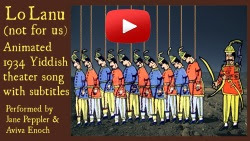
UPDATE: Reposting to add the animated video I did today. Nobody ever listens to the automatic videos created by Routenote of the songs from our cds so I thought I'd make one today and see if it gets some listeners:


Here's something very interesting about the fellow I called here (in the second verse) "Vayzote" but who, it seems, is called in Yiddish Vayzuse and whose name is also used for "idiot." He was Haman's youngest son. You can read a great blog article about him, from the Mayrent Institute blog, here: Vayzuso. And there is a wonderful recording from way back in 1901 made by Dave Franklin, "the king of comic singers." A great song and a great read!


Click the picture to listen to and/or buy this track, Di naye lo lanu, from our Lebedik Yankel cd. Aviva Enoch plays the piano on the cd.

(Picture: Mordechai on his horse, as mentioned in the song!)

And here is a live concert version with Roger Lynn Spears playing piano:


This song was printed twice in the collection (once in 1929 and once in 1934) which indicates it must have been pretty popular! As with "Di Naye Al Chet" and "Me Shoklt Zikh," the song begins in a religious setting (pious Jews praying at Sukkot and waving their lulavs). It plays with the line from the Halleluja, "Lo Lanu" (not for us but for you, God) and the similar "lo eleinu" which means more or less, "let it not happen to me/us!" Having set the proper context, it then wanders off and applies the concept in a more secular context.

Aviva and Roger both do a great job of interpreting the accompaniment as heard on the Herman Fenigstein 78 found at Harvard's Judaica Collection. (Fenigstein sings the same first verse as noted in Zhelonek's book, but his second and third verses are different.) Although ordinarily I adapt lyrics to standard Yiddish (because that's what I know), in this case many of the rhymes won't work unless one sings "Lo lani" (what he sings sometimes sounds more like "Loy lani") so that's what I did.


» » Read the rest of the article » » » »

Labels: , , , , , , , ,

Sunday, July 3, 2022

Yosl un Sore-Dvoshe: a tale of a lover's spat which culminates in a noisy trip to the theater

UPDATE to add video from our May 2022 concert at the Shadowbox. We just did the first two verses and went out with a bass solo.

This is Kasriel Broydo's send-up of Fanny Gordon's tango Milosc cie zgubila.That's Fanny in the picture. She was the only female composer I know of working successfully in the Polish cabarets and nightclubs between the World Wars.

This Yiddish version was sung in Europe by Mina Bern and Joseph Widetzky.

I love how the loving couple displays behavior that must have been so aggravating to the singers: they sneak into the theater for free, they snap and crunch sunflower seeds and cookies in the front row and they even eat fruit compote and nudge around with their pal Velvl.


You can listen to or buy the cut from our album here: Yosl un Sore-Dvoshe on Cabaret Warsaw: Yiddish & Polish Hits of the 1920s - 1930s by Mappamundi


Here's my translation from the Yiddish:

» » Read the rest of the article » » » »

Labels: , , , ,

Sunday, June 26, 2022

Sex Appeal! Sung (then) by Benzion Witler and Adam Aston - now by Mappamundi!

UPDATED so I can post the video we made last month at the Shadowbox Studio, thanks to Mark Sidell for the audio and Paul Deblinger for the video. This was one of the first songs Beth and I found that existed in both a Polish version, lyric is by Ludwik Starski (see the iconic performance by Eugeniusz Bodo singing "Sex appeal" in drag) and a Yiddish version, written by Igor S. Korn-Teurer, more famous for serious Holocaust poetry. (Menasze Oppenheim singing "Sex Appeal" in 1938)
If you want the words write me.

Labels: , , ,

Thursday, June 23, 2022

Der Dales - Nikodem - Yiddish and Polish versions of the same theater song

UPDATED to add a video made from our May 8 2022 concert. 

When my band Mappamundi was making the Cabaret Warsaw cd, we were looking for songs from the 1920s and 1930s which had both a Polish and a Yiddish version, and this song was one of them.

We wondered which came first until I found, at YIVO, Ben-Zion Witler's copy of this published sheet music for Nikodem with his own handwritten lyrics, in Yiddish, tucked inside. In my later research I've found several Polish songs which he re-wrote for his own repertoire.

The Polish version is about an obnoxious guy who thinks he's hot stuff. Witler's version is more interesting - it's about the anthropomorphized concept of Poverty as a sentient creature who comes to live with you and, sadly, like a leech of an uninvited guest, will not leave.
 

We recorded it for our Cabaret Warsaw cd: Der Dales and Nikodem by Mappamundi. We sing two of the three verses Witler recorded and then just the chorus of the Polish version (Nikodem) by Starski and Wars.

Here's my translation of the Yiddish lyrics. For a charming description of "Der Dales" (Mr. Poverty) see the bottom of this post.
» » Read the rest of the article » » » »

Labels: , , , , , , , ,

Wednesday, June 22, 2022

An eytsele tsum vaser-treger (Advice for the water carrier) - Moyshe Broderson and Henech Kon

UPDATE: We recently got a rare opportunity to sing this song, at the Shadowbox Studio. Paul Deblinger filmed it and Mark Sidell ran sound off the board and so here is a new video.

Way back in 2010, Beth Holmgren and I were very taken by a video we heard on Youtube of Ola Lilith and Willy Godik singing together, An'Eicele, 1928 - "(Text Moses Brodersohn, Musik H. Kohn) - Ola Lilith u. Wł. Godik aus jüdischen Revue-Theater, mit Orchester Begleitung, Homocord Pl.29078, Wyrób Polski (Polish) c. 1928"

In standard transliteration that would be An eytsele (Some Advice).

I wasn't satisfied with my ability to transcribe the words and, besides, it was about women from various places and how lousy they would all be as wives, we didn't want to sing that. So I replaced the text with one from the Itzik Zhelonek's lost songs, one that at the time was still lost (ie had no melody) but which I have since found: Der vaser treger as sung by Moshe Kraus. Though I didn't know it then, Der vaser treger was also written by Moshe Broderzon and Henech Kon. I added a different punch line. (In the original song, the punch line is, "so we don't have any potatoes to go with our bread - God will provide.")

Here's us singing the concocted song for the first time:


Here are the words. If you ever sing it (or any of the others) please let me know and I'll link to your performance!
» » Read the rest of the article » » » »

Labels: , , ,

Thursday, April 28, 2022

Oy, vi es tyokhket! Oh, how it throbs! Concerning love and the yeytser hore

UPDATE: Six years after I last posted this song, Arye Menachem has found a recording of Aaron Lebedeff singing Es Tyokhket (which was at the time transliterated by the record company as Oy Vie iz Tchurckit) and has posted it on youtube with the lyrics and a rhyming version in English: "Es tyokhket." Enjoy!

Six years ago I re-upped this post with a (now obsolete but funny) Instagram 60-second video excerpt:


Or click the album cover to hear and/or buy this track from our cd Nervez!


The Yiddish word yeytser is sometimes translated mildly denotes lust or desire for - something and yeytser hore is the scolding terminology for wanting sex.

Itzik Zhelonek cited a Pinkhus Sapir recording of this song, noting that it was from the show Der eybiker nar (The Eternal Fool) but I couldn't find that recording.

My transcription is from the singing of the "Betty Koenig / Kenig from her Syrena Grand Records 5286 Es tiochket. Obviously she sang the song from a woman's point of view and, as I am a woman, I chose her lyrics over Sapir's.


My translation from the Yiddish:
» » Read the rest of the article » » » »

Labels: , , , , , , ,

Friday, September 3, 2021

Khsidemlekh zingen (Khsidemlekh tantsn) - Yiddish theater song by Yosele Kolodny

UPDATE:Reposted to add (on the right) a brand new singalong version (I hadn't thought of that back in 2016 when I last posted this song). On the left, a live version from the very first time pianist Aviva Enoch and I performed the song. Maybe 2011? Ah, time flies.


Yosele Kolodny, composer of this song, died in the Holocaust. Little is known about him. He was composer of another song in the Itzik Zhelonek collection - Dem Rebns Shirayim - which I have not been able to find (it's possible it was sung to a tune very much like this one, the scansion is similar). In the book The Jews of Pinsk, 1881 to 1941 Yosele Kolodni is mentioned as a young actor, a Pinsker, married to Ulia Rabinowitsch, performing in a comedy called Dolarn in 1923.

Zhelonek sold (and transcribed) a 78 made by Yossele Kolodni himself, but I haven't found it. Ben Bonus sang the song - as a cheery tango - and that's what I transcribed (download his version here). It's at the Dartmouth Jewish Sound Archive. At the Freedman catalogue you can find mention of quite few recordings of the song, which is sometimes called Khasidemlekh Tantsn and sometimes Khasidemlekh Zingen. These include a performance by Ben and Florence Belfer available online in the Florida Atlantic University collection: Khasidimlakh. Chava Kramer sent me the link.

Click the album cover below to hear and/or buy this track and all the others from our cd Nervez!


hasidic dancing


The slippers and socks mentioned here are cited in Wikipedia:

Hasidim in the mid-19th century show a far more Levantine outfit (i.e. a kaftan lacking lapels or buttons) that differs little from the classical oriental outfit consisting of the kaftan, white undershirt, sash, knee-breeches (halbe-hoyzn), white socks and slippers (shtibblat). This outfit allegedly had a Babylonian origin before its later adoption by Jews, Persians and lastly the Turks, who brought it to Europe.

Here's my translation:
» » Read the rest of the article » » » »

Labels: , , , , , , ,

Sunday, February 7, 2021

Dir a nickel, mir a nickel - from Fishel der gerotener, a song about getting ahead as a trolley conductor

This song is in the Kemmen Folio of Famous Jewish Theatre Songs I bought on eBay. It's from the show Fishel der gerotener. Gerotener means a well-made, all round class A type of person, but Menashe Skulnik played the hapless trolleyman so you know the nickname was sarcastic. The lyrics are by Isidore Lillian and the music is by Joseph Rumshinsky.

It could be "Dir a nikl mir a nikl," but the correct way to spell nickel in Yiddish is problematic, since at the time the Jews were cramming English into their vocabularies as fast as possible. You'll also find it as Fishl der Konduktor. Fishel is enjoying the shmirn (smears, bribes) that come his way.

The idea was stolen from a previous (1917) Yiddish theater hit, Fifty-fifty, in which we see:

Mayn bruder iz arumgegangen gebrokhn a lange tsayt.
Keyn zakh iz im nit gelungen, vos er hot getrayt.
Af eyn mol kumt er aheym mit gelt un zogt tsu mir; you see,
Ikh bin conductor af a kar un teyl zikh mit der company—

Fifty-fifty, Fifty-fifty, oy oy oy, fifty!
Ikh kling di bel gor on a shier.
A nickel far zey un a nickel far mir;
Fifty-fifty! es geyt bay mir af stim.
A tsi dos shtrikl, s'iz do a nickel
Mit fifty-fifty-skem!
My brother's been going around broke for a long time. Nothing he's tried has been a success. Once he came home with money and told me: "You see, I'm conductor of a trolleycar and share with the company: Fifty-fifty! I ring the bell endlessly, a nickel for them and a nickel for me! It's going gangbusters. A tug on the string, there's a nickel, with the fifty-fifty scheme!"

I hadn't intended to make a video of this song because Bruce Adler did a great one, with subtitles, and an orchestra! His version is featured at the Milken Archive where you can read the plot of Fishl der gerotener. (I have special interest in this show because Ola Lilith played one of the love interests.)

But then my friend Aviva Enoch and I ended up doing a version one afternoon just for fun and I forgot about it until I started trying to figure out why the song "Fifty-fifty" sounded so familiar... Anyway, the file lay in my computer for six years. Here it is.


If you want the sheet music with lyrics, translation, chords, etc., here it is:


My translation:

» » Read the rest of the article » » » »

Labels: , , , , ,

Friday, September 14, 2018

S'iz gut far mir (It's good for me) aka Sgit far mir - an old song recently revived.

The Forvert recently featured this song called "S'iz gut far mir" aka S'iz git far mir - "It's good for me," as sung by Levy Falkowitz. Here's his version is on Youtube:

לוי פולקוביץ ותזמורתו של יוחי בריסקמן "ס'גוט פאר מיר" | Levy Falkowitz - Yochi Briskman Orchestra


Falkowitz credits the song to Boruch Hass, who performed it at "Sliches night in Kiev" in 1992. Hass wrote the second verse (and removed a reference to a pretty girl in the third verse) but otherwise...

... the song actually goes back many decades. Max Perlman sang it throughout his career, crediting it to Aaron Lebedeff.

Here is a relatively modern Perlman version, from "Max Perlman Greatest Hits Vol 1."


Perlman's first and second verses are also sung by Falkowitz, but his third verse is about politics (see below).

And here is a great version sung by Henri Gerro:


In the Henri Gerro version the second verse is about a pretty girl and the third verse is about a car, but I don't have the lyrics for you.

Lyrics in transliteration and translation after the jump. If you want the sheet music write to me.


» » Read the rest of the article » » » »

Labels: , , ,

Tuesday, August 21, 2018

Tsen kopikes hob ikh (I have ten kopecks) - Aaron Lebedeff hit - first of the new shlager series!

At "Trip to Yiddishland 2018" last week I was talking with Alec Burko about his amazing project, the Yiddish Dialect Dictionary. We both love obscure corners of Yiddish culture. I said "people are only ever searching for the same few popular Yiddish songs, like Mayn shtetele Belz. They don't know to search for something they have never heard before."

Alec suggested I should put some of the most popular Yiddish songs on this blog, and then when people found them, they might stick around and look at some of the less famous songs and might even realize the rare ones are JUST AS GOOD AS the ones they already know. Or better.

So I'm going to follow his advice and put some hits on this blog (shlager means a hit). I'm starting with Tsen Kopikes; somebody was going to sing it at one of the cabarets at Trip to Yiddishland and Eli Rosen asked if I'd accompany the guy. I would have, happily, but the guy chickened out. But it's a great song! It may have been at least partially a folk song, fragments of the lyrics were collected and printed by folklorist Shloyme Bastomski.

Here's the classic Aaron Lebedeff recording -

>

By the way, the whole compilation album Odessa Mama is one hit after another, highly recommended.

If you want the sheet music with chords, email me. The Yiddish lyrics (words and translation) are here after the jump.

» » Read the rest of the article » » » »

Labels: , ,

Thursday, August 9, 2018

Don der Dondek (Don the Ninny) - my personal protest song (with subtitles) against Combover Caligula


In 2015 I submitted a song to "Der Yidisher Idol" - known as "Der Idisher Idol" in Mexico City, which is where the competition took place. I got an all-expense-paid trip to Mexico City to sing in the contest, and I won. Read about me getting chosen as Grand Champion of Der Yidisher Idol 2015.

I wrote Don der Dondek for this year's competition but it was rejected for two reasons: "We don't mix politics and culture," and "You already won so you can't compete again." Fair enough.

Writing this was cathartic, and Yiddish is, as you know, an excellent language for insults. I used two dictionaries and Nahum Stutchkoff's Rhyming Dictionary and also his thesaurus. Afterwards my friends did overdubs, Randy Kloko sang on the chorus, Jim Baird played bass and Ken Bloom played guitar. Thanks guys! The translation is after the jump, if you want the Yiddish text just email me.


» » Read the rest of the article » » » »

Labels: ,

Wednesday, January 3, 2018

Vos kh'hob gevolt hob ikh oysgefirt: an Aaron Lebedeff yiddish show tune made over for a girl klezmer band

UPDATE: I just found this song (without the catchy chorus, though) in a 1920 book put out by Y. L. Cahan called Yudishe Folkslieder (Yidishe folkslider) or in English "Yiddish Folksongs with Their Original Airs Collected from Oral Tradition" - the sheet music is at the bottom of this post, after the jump. And it turns out this original folksong is from a woman's point of view!


cabaret dancer 1930
You'll find this song spelled: Wus hob gewalt, hob ich oysgefirt and it was recorded by Aaron Lebedeff, with the Abe Schwartz Orchestra, as Ay, ay, vos kh'hob gevolt, hob ikh oysgefirt. written by Herman Wohl and Louis Gilrod, the song was in Israel Rosenberg's show Yankele Litvak in 1924.

David Medoff recorded it in 1923 as Vos Ich Hob Gevolt Hob Ich Ausgefirt, translated there as "What I Wanted, I Found."

I heard the Lebedeff recording when I was at Florida Atlantic University. The words were hard to make out, but I didn't try very hard because it was all about a wife, so I decided to take snatches of what I heard and incorporate them into a new version suitable for a women's klezmer band. I couldn't do it justice as I was alone and didn't have a klezmer band with me - it deserves the whole nine yards. And drums.

If you want to write your own words too, I suggest you get a copy of Stutchkoff's Yiddish thesaurus and his Yiddish rhyming dictionary (Yidisher gramen-lexicon) and then have at it!

Continuing experiment with green screen. The glasses I wore today had a lot of glare. You live and learn.


Here's the English translation of the Yiddish lyrics I sang:

What I wanted, I succeeded in, let me go on that way.
I wanted good luck and God gave it to me.

» » Read the rest of the article » » » »

Labels: , , , , , ,

Monday, September 4, 2017

Me darf makhn a lebn (You gotta make a living) as composed and performed by Leo Fuchs

Leo Fuchs was a physical comic and an amazing dancer. He was one of the youngest of the really gifted Yiddish theater actors and so had the opportunity to make movies.

A reader of this blog wrote me and asked if I could provide the sheet music for this song, which is variously transliterated Men Darf Machen A Leben, Men Darf Majen A Leiben, and M'darf makhn a laybn.

I suggested he get in touch with the fine Yiddish singer Yanky Lemmer (whom he had heard performing the song) and Yanky generously provided the Yiddish lyrics. So I did make the sheet music, write me if you want it.

Here is the song as Leo Fuchs sang it back in the day, with a sing-along Yiddish transliteration and my translation in the captions / subtitles:


"Me darf" can also be translated as "one ought to," "One needs to," "Everybody needs to," etc.

I like this idea in the second verse: Leo Fuchs does not caper and play the fool because he wants to. He does it because everybody has to make a living.

Words after the jump.

» » Read the rest of the article » » » »

Labels: , , ,