
Az der rebbe vil - a naughty song by Ludwig Satz. Just imagine all the things our rebbe can do!
UPDATE: I made a new video with the lyrics transliterated and the translation. Maybe somebody besides me would enjoy singing this song!

Miriam Isaacs, who's been researching the Stonehill Collection at the Holocaust Museum, told me most of the dirty songs Ben Stonehill recorded at the Hotel Marsellaise were about rebbes. And here is one. It was written by Ludwig Satz, I found the recording at the Harvard Judaica Collection. Zhelonek, however, transcribed a recording of the song by Herman Fenigstein, I've never seen or heard that recording.
So there were three sets of words: the words Satz scrawled on a cocktail napkin or whatever and sent to the U.S. Copyright Office; the words he recorded; and the words Zhelonek transcribed. It seems to have been the rule that when somebody took somebody else's song into their own repertoire, they would re-write the words. So I chose the bits I liked best from those three versions and that's what I recorded yesterday. The song will be going on Nervez!, the last Itzik Zhelonek cd.
Here's our version. Roger Lynn Spears is playing piano, Randy Kloko is singing on the chorus.

And here is a video from one of our concerts:


The picture is of Ludwig Satz and Lucy Levine in the show called His Wife's Lover.
Below, my translation of what I sang.
» » Read the rest of the article » » » »
Labels: der rebbe, fun, humor & satire, klezmer, nostalgia, religion, songs for sale

 This is another of those great songs which start out in the synagogue and leave by the back door. From Wikipedia:

 My transcription is from the singing of the "Betty Koenig / Kenig from her Syrena Grand Records 5286 Es tiochket. Obviously she sang the song from a woman's point of view and, as I am a woman, I chose her lyrics over Sapir's.


 Today I got yet another request for this song, one of the most popular songs in the Yiddish theater song repertoire. Oy, mame, bin ikh farlibt was written by Abe Ellstein for Joseph Green’s 1936 film Yidl mitn fidl. Joseph Green's films are priceless because they were shot in Poland just before the holocaust. A lot of the crowd scenes were shot with locals and passers-by.

 UPDATE: Reposting because somebody just emailed me and asked for a sing-along version of this song.
 This is one of my favorites among the Zhelonek songs: great melody and great lyrics. I fault its cynical fin de siecle tone for its being wiped off the face of the earth.


 This photo by Bill Brandt shows a girl from the Cockney (and also Jewish) part of London, doing a dance created to the song "The Lambeth Walk" from the 1937 musical Me and My Girl (about a Cockney barrow boy who inherits an earldom but almost loses his Lambeth girlfriend). On Youtube you can find the original star, Lupino Lane, dancing and singing the song.
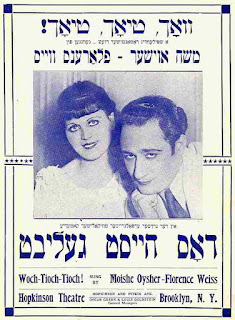

 I'm kind of embarrassed that I like this song so much because it is old-school, as misogynistic as they come. I dedicate this performance to discographer Michael Aylward, who loves the song as much as I do. I heard it on his cd


 We had fun discussing this song in my Yiddish class. Shtek arayn (shtekt arayn for plural or formal) literally means "stick it in" and so we all jumped to the obvious conclusion before reading the song's lyrics.


