
Lebedik Yankel (Lebedig Yankl, Lebedig Yankel)
UPDATE: Reposted to add the new singalong Yiddish music video, part of my campaign to get other people to sing these songs:

Or visit to the whole track from our cd of the same name: Lebedik Yankel.
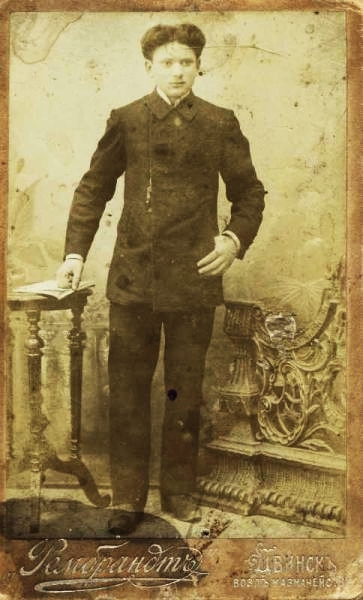
This is yet another song about a guy who is not supporting his family because he's too busy praying. Well, he does have an occupation of sorts: he repairs crummy old shoes. (This guy doesn't look very lively, does he!?)
Itzik Zhelonek labeled it "folk song sung by Herman Fenigstein." Morris Rund, however, copyrighted the lyrics and credited Aaron Lebedeff (or Lebedoff as it says on the card in the copyright office card catalog) as composer of the music. For the sheet music I transcribed an older recording of this song sung by Aaron Lebedeff, but that cut was taken down. If that was for copyright reasons, it was unnecessary, as Lebedeff never renewed the copyright and the song is now in the public domain. Luckily somebody else has posted a newer version by Lebedeff (it desn't have the chorus members who were on the previous recording): Aaron Lebedeff's Lebedik Yankel.
I found the last verse not on the recording or in the Zhelonek collection, but online.
 I chose this as the name of the second Itzik Zhelonek cd because it was one of the few titles I thought everybody would pronounce. I didn't use the YIVO-sanctioned spelling of "Yankl" because it would worry English speakers.
This song contains the worst tongue-twister I've ever encountered in my life - "zorg zikh nisht mayn vaybl, zorg zikh nisht mayn taybl." I practiced it over and over and still couldn't get it. I was tempted to substitute something that's easier to say.
When Randy came up from Florida, he added the chorus and I added some oom-pah on fiddle and viola.
Translation of the Yiddish lyrics:
» » Read the rest of the article » » » »
Labels: battle between the sexes, klezmer, making a living (poverty), religion, songs for sale


 The song was sung in Kalmanovitsh's 1924 show 'Dem tatn's zundele' and Zylbercweig credits Peretz Sandler as lyricist. In the manuscripts of the Hebrew Actors' Union housed at YIVO, "Dem Tatns Zindale" is credited to lyricist Oscar Ostroff and composer Ilia Trilling. However, in the Library of Congress one finds the song copyrighted in 1928 by lyricist Morris Rund and composer Herman Wohl. Morris Rund registered a tremendous number of copyrights of Yiddish theater songs - did he actually write them or were his claims false? How can we ever know?
 This one: copyright 1928, words by Morris Rund, music by Sholom Secunda. It's a strange tune. Aviva Enoch is playing piano, thanks, Aviva. Randy Kloko sings bass on the chorus.
 This is another of those great songs which start out in the synagogue and leave by the back door. From Wikipedia:


